Szklarska Poręba
Location
Szklarska Poręba
Jelenia Góra
14
January
-
13
January
Date of stay
Number of people
2
search
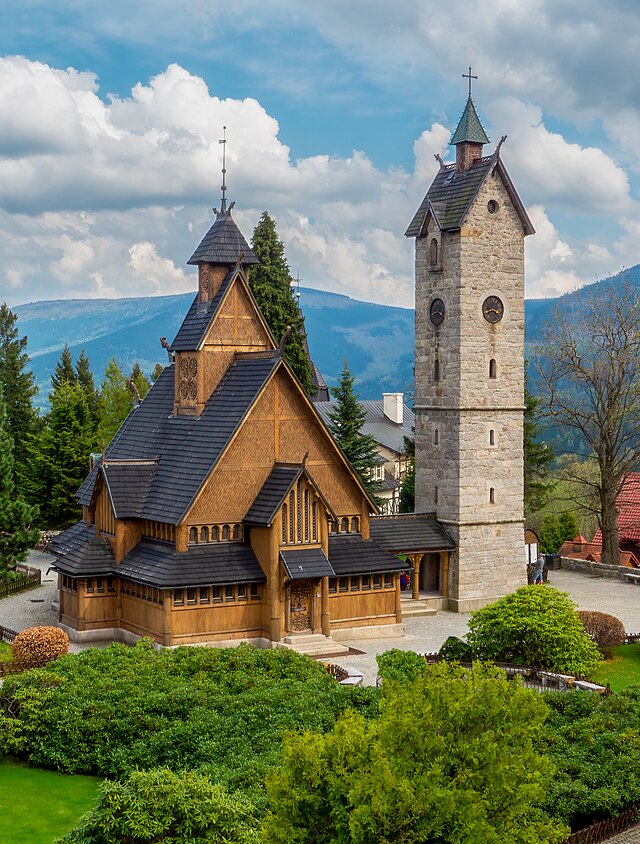
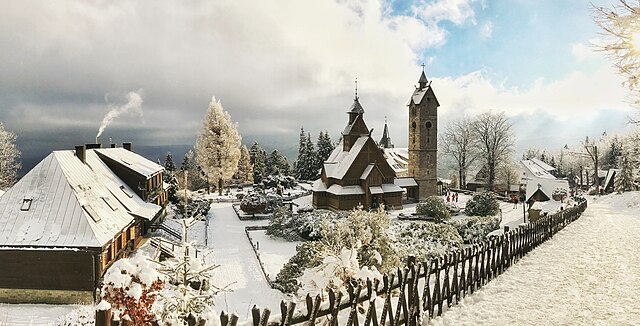
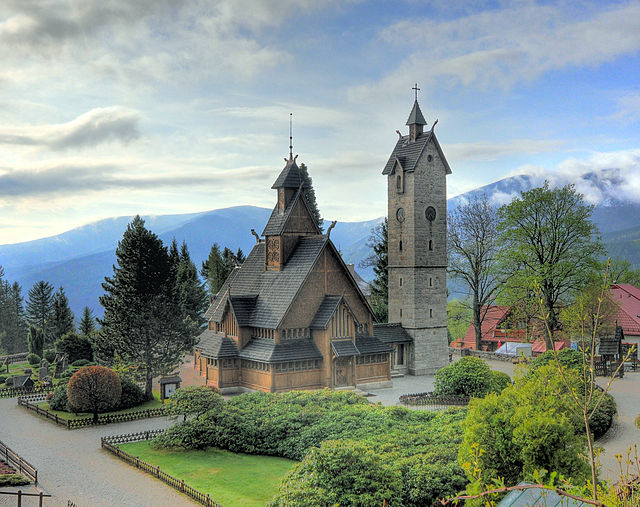
The Wang Church was built at the turn of the 12th and 13th centuries in southern Norway, in the town of Vang, situated on Lake Wang. This is where its name comes from. In the 19th century, the decision was made to sell it. This monument of Viking architecture was purchased for 427 marks by the Prussian King Frederick William IV.
In 1841, the structure was dismantled and transported in crates by ship to Szczecin, and then to the Royal Museum in Berlin. Thanks to the efforts of Countess Friedrich von Reden of Bukowiec, the church was relocated to the Karkonosze Mountains in the spring of 1842 to serve the Protestants living in Karpacz and the surrounding area. The building site was donated by Count Christian Leopold von Schaffgotsch of Cieplice.
This is the slope of Czarna Góra (885 m above sea level), located halfway from lower Karpacz to Śnieżka. To create several hundred square meters of building land for the church, rectory, school, and cemetery, rocks were broken up and a six-meter-high retaining wall was erected. On August 2, 1842, King Frederick William IV personally laid the cornerstone, and two years later, on July 28, 1844, the church was officially opened and consecrated in the presence of the king and his wife, Crown Prince Frederick of the Netherlands, and many other prominent figures. The Wang Church was built in the style of a Viking ship, without the use of nails, using only wooden pegs and notches. The church is made of Norwegian pine, which, saturated with resin, demonstrates remarkable durability.